
CPL, CAC, LTV, ROI: The Marketing Metrics Your CEO Actually Cares About
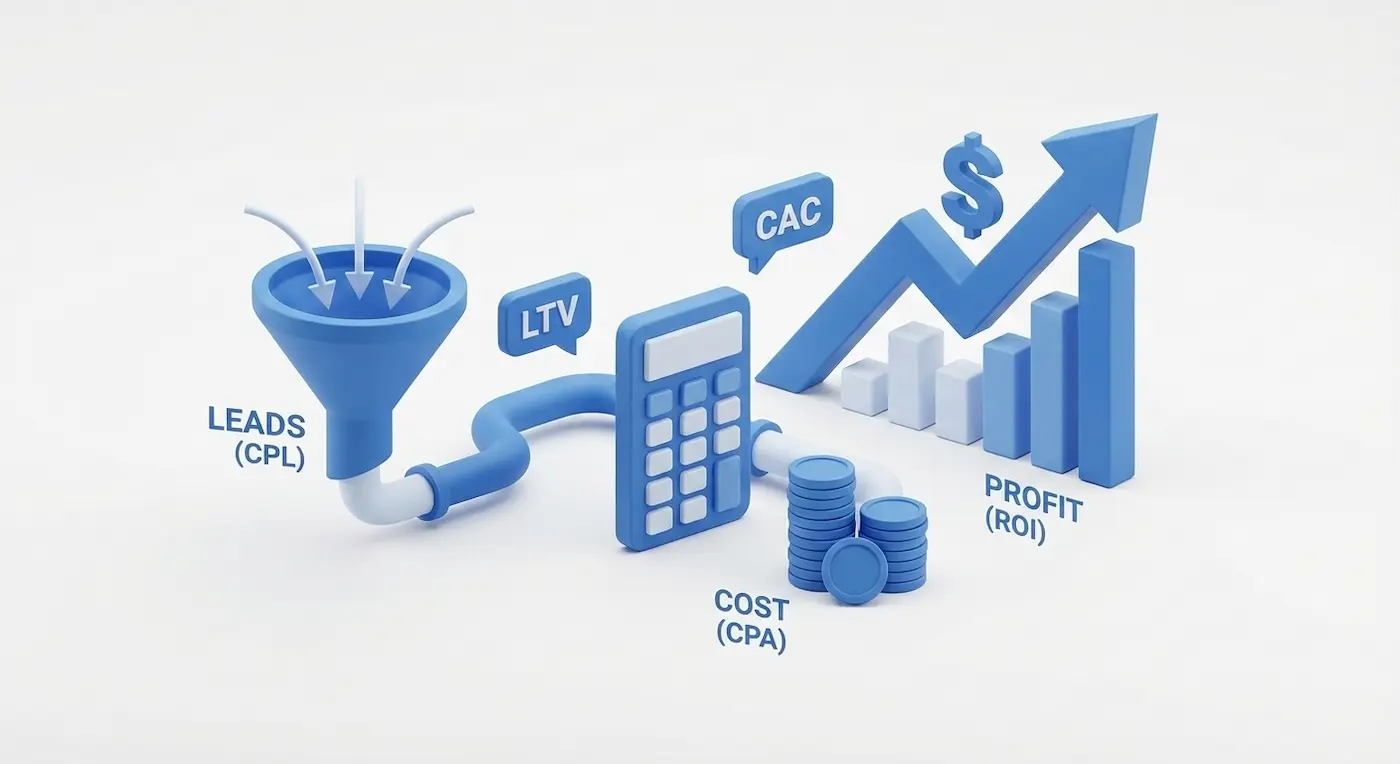
CPL, CAC, LTV, ROI: The Marketing Metrics That Actually Matter to a CEO
Introduction: The Problem of "Different Languages"
It is a typical Monday morning pipeline meeting. The marketer proudly reports: "We reduced our cost per click (CPC) by 20% and boosted the CTR on our latest ad sets!" The CEO frowns and asks: "Excellent, but why is the cash flow in the bank account exactly the same?"
The underlying issue is that marketing departments and business executives often speak completely different languages. Marketing traditionally measures processes (clicks, impressions, reach, likes), while business strictly looks at bottom-line results (revenue, closed deals, net profit).
For a meaningful strategic dialogue to happen, you must switch to the language of Unit Economics. In this guide, we will break down the four critical acronyms that separate a highly profitable business from a failing one.
1. CPL (Cost Per Lead)
What it is: The exact amount of money you pay to acquire a single potential customer's contact information (a website form submission, a phone call, or a direct chat message).
The Formula:
- Example: You spent $1,000 on Google Ads and generated 50 leads. Your CPL is $20.
The Trap: In the B2B sector, not all leads are created equal. A college student downloading your technical checklist to write a research paper is technically counted as a lead, but they have zero buying power. This is why you must segment your pipeline:
- MQL (Marketing Qualified Lead): A user who engaged with your content and showed initial interest.
- SQL (Sales Qualified Lead): A vetted prospect who has confirmed budget, authority, and an active project need.
Pro Tip: Calculate your CPL specifically for qualified leads. If your cheap leads never progress down the sales funnel, you are simply funding junk traffic.
2. CAC (Customer Acquisition Cost)
CPA (Cost Per Action) and CAC are frequently conflated across marketing blogs. From a business health perspective, we care strictly about CAC—how much capital it takes to acquire a single, revenue-generating customer.
What it is: The fully loaded cost of winning one closed contract. This metric accounts not just for direct advertising budgets, but also for marketing salaries, software subscriptions (CRM, automation platforms), and sales commissions.
The Formula:
- Example: You spent $1,000 on ads + $1,000 on your marketing team’s retainer, acquiring 5 new clients. Your real CAC is $400.
Business Insight: If your Average Order Value (AOV) or initial contract value is $300, but your CAC is $400, your business model is bleeding cash. Every new transaction pushes you deeper into a deficit.
Crucial Distinction: CAC vs. CPA
To evaluate your operations accurately, you must understand the operational difference between these two terms:
- CPA (Cost Per Action) represents the cost of a micro-conversion or specific user behavior (e.g., a phone call, a form download, or a cart completion). It is fundamentally an advertising platform metric.
- CAC (Customer Acquisition Cost) represents the total macro-investment required to land a final paying client across the whole business ecosystem.
- Example: Your CPA for a lead submission in Google Ads might look highly efficient at $15. However, if only one out of ten leads actually converts into a paying customer, your ad-only CAC scales to $150 (before adding internal overhead costs).
3. LTV (Lifetime Value)
In B2B environments characterized by long sales cycles or recurring subscription models (SaaS, retainer agreements, ongoing IT maintenance), judging performance based on the initial sale alone is a major mistake.
What it is: The total projected revenue a single customer will generate for your company over the entire duration of your commercial relationship.
- Example: You sell server infrastructure management for $100/month. On average, a client retains your services for 2 years (24 months). Your LTV is calculated as follows
The Golden Rule: A business architecture is fundamentally healthy and scalable if:
This means a client must generate at least three times more revenue than the total capital spent to acquire them.
- If LTV = CAC, your business is simply trading dollars and working for zero net return.
- If LTV < CAC, your marketing strategy is toxic, and you must pivot your targeting immediately to prevent insolvency.
4. ROI / ROMI (Return on Investment)
The ultimate question every executive asks before signing off on a strategy is: "For every single dollar we inject into this channel, how much net profit do we make back?"
What it is: The definitive efficiency ratio of capital invested. In digital marketing, we isolate this via ROMI (Return on Marketing Investment).
The Formulas:
Example: You invested $1,000 into a campaign. It generated new customer accounts that yielded $5,000 in gross profit.
This represents an exceptional operational return. If your ROMI is above 0%, your campaigns are actively paying for themselves.
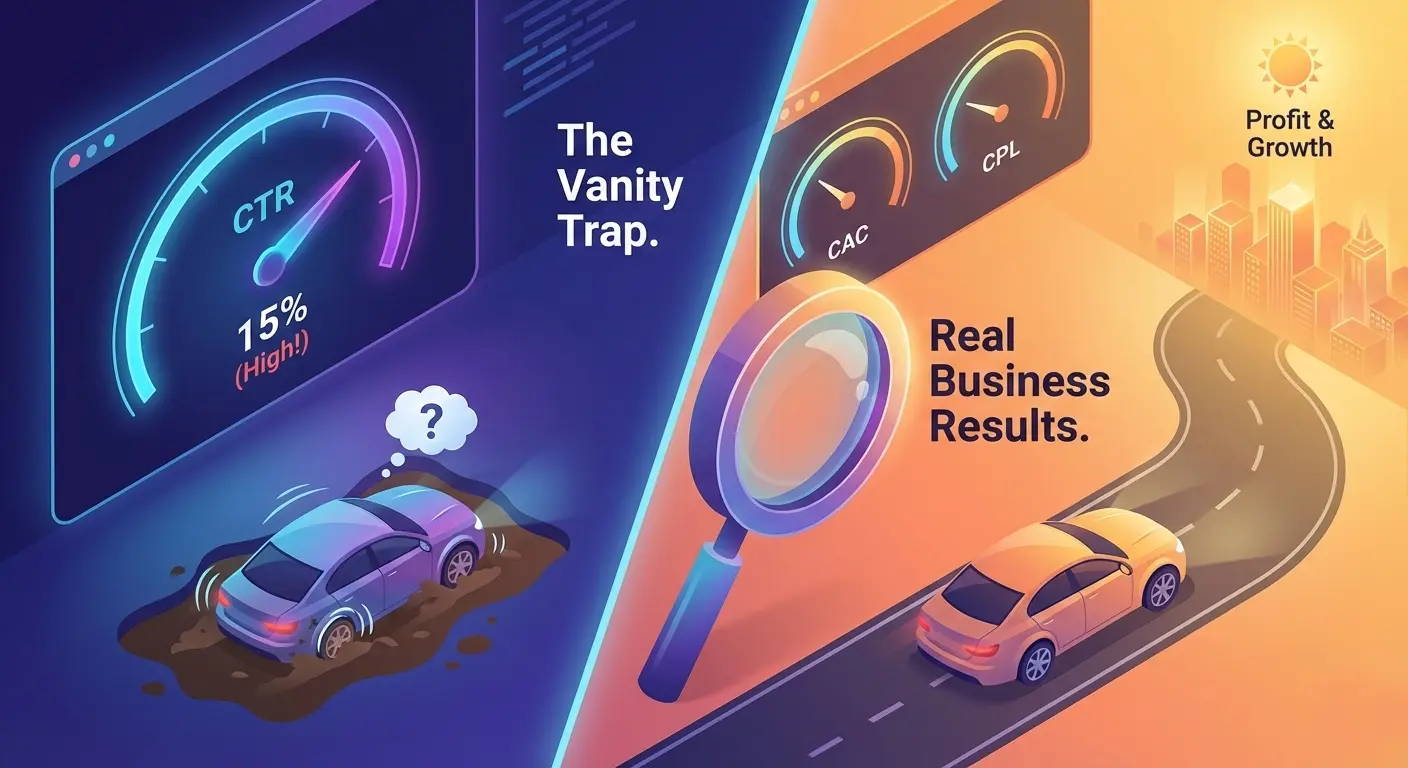
The Danger of Vanity Metrics
What about high CTRs, low CPCs, low Bounce Rates, or an increasing follower count on corporate social accounts?
Exclusion is the best policy. Remove them entirely from executive leadership reports. Technical metrics are critical diagnostics for an ad specialist to optimize a campaign, but a CEO cannot pay payroll with click-through rates if the phones are not ringing. Never substitute process for profitability.
How to Implement Data-Driven Tracking
You cannot optimize what you do not actively measure. Here is how to establish your unit economics foundation:
- Deploy End-to-End Analytics: Bridge the gap between your CRM and Google Analytics. You must be able to trace exactly which specific ad channel, landing page, or keyword initiated the lead that closed a high-ticket contract six months later.
- Enforce Strict UTM Governance: Every single outbound hyperlink in your blog posts, cold emails, newsletters, and paid ad creatives must contain clean, standardized UTM parameters.
- Start Manually If Needed: If your company lacks a fully integrated CRM infrastructure, do not let that stall your tracking. Build a clean, secure spreadsheet. Once a month, document three baseline variables: Total Ad Budget, Total Verified Leads, and Total Closed Deals.
Conclusion
High-performance marketing is not an opaque art form driven by luck—it is an engineering discipline rooted in mathematics. The moment you audit your operations through the exact lenses of CPL, CAC, and LTV, your entire business perspective changes. You stop "spending cash on advertising" and start "allocating capital to predictably purchase paying clients."
Related Articles:
What is CTR and Why It Doesn’t Matter for Your Business
Google Analytics 4 (GA4) for B2B Founders: The Only 3 Reports You Actually Need
Read new articles:








Рентабельные рекламные кампании в Яндекс.Директ
Настроим и будем вести контекстную и таргетированную рекламу для вашего бизнеса
Создадим систему привлечения новых клиентов
Уменьшим цену входящего звонка и заявки
Увеличим заказы на маркетплейсах: Ozon, Yandex Market, WB
Подготовим понятные отчеты и аналитику