
A/B Testing Guide 2025: Stop Guessing, Start Converting
Picture a meeting at a typical company.The marketer says, "We need to make the button green; it's the color of money."The designer objects, "Green doesn't fit our brand book; the button should be outlined."The CEO walks by and drops a comment: "Put a picture of a smiling girl there; I read somewhere that it works."
Ultimately, the person with the highest salary wins (this is called the HiPPO effect—Highest Paid Person's Opinion). The changes go live, the budget is spent, and sales... plummet.
Why? Because you tried to guess the behavior of thousands of people while sitting in a room with five colleagues.
In 2025, guessing is too expensive. Smart companies don't argue; they run A/B tests. Today, we'll break down this scientific method for increasing profits—the method that separates professionals from amateurs.
Part 1. What is A/B Testing? (Explained Simply)
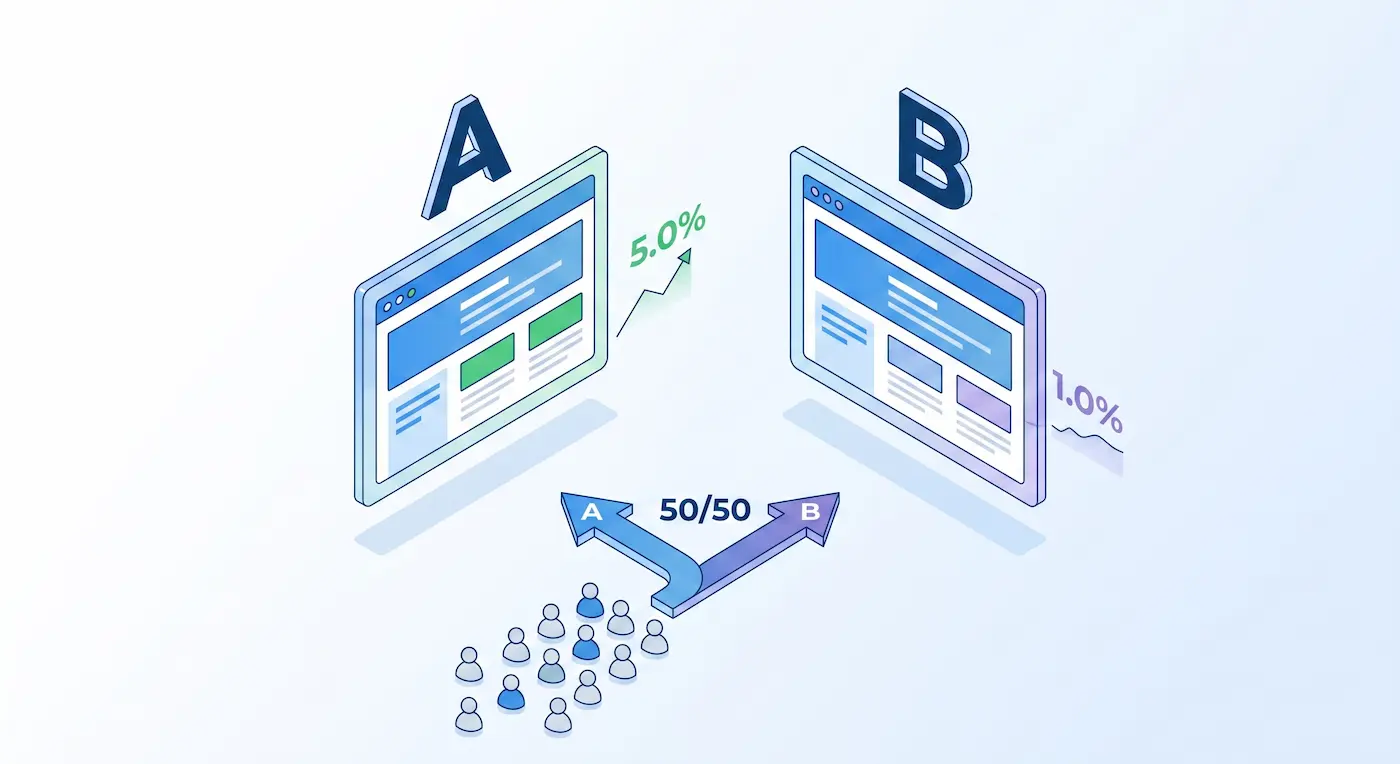
A/B testing (or split testing) is a method where you show two different versions of a single page to two groups of users to figure out which one sells better.
- Audience A (50%) sees the old version of the site (the Control variant).
- Audience B (50%) sees a new version where you changed just one element (for example, the headline).
At the end of the experiment, you look at the numbers.
- Variant A: Out of 1,000 visitors, 20 made a purchase. Conversion: 2%.
- Variant B: Out of 1,000 visitors, 30 made a purchase. Conversion: 3%.
Does a 1% difference sound small? It’s not. You just increased your sales by 50% out of thin air, without spending a dime more on advertising. That is the magic.
Part 2. Life After Google Optimize: What to Use Now?
For a long time, the free Google Optimize tool was the industry standard. But in September 2023, Google shut it down, leaving the market scrambling. What should businesses use in 2025?
- VWO (Visual Website Optimizer): Currently the global leader. Powerful and user-friendly, but paid and fairly expensive for small businesses.
- Built-in CMS Tools: Many platforms like Tilda or Bitrix24 have built-in A/B testing modules. This is the easiest route for beginners.
- Specialized Enterprise Services: Optimizely, AB Tasty, or Crazy Egg.
- Custom Scripts: You can swap content using Google Tag Manager (GTM), but you’ll need a smart developer for that.
Advice: If you use a website builder, start with its native tools. If you have a complex custom site, look into VWO or emerging regional alternatives.
Part 3. What to Test? The "Big Three" Hypotheses
Beginners often test nonsense: the color of borders, the font in the footer, or social media icons. This is just polishing gravel. To get a 20–30% boost, you need to target meaning.
Here are the three elements where changes yield the strongest impact:
1. The Headline (The Offer)This is 80% of your success. If a user doesn't understand what you offer within 3 seconds, they will leave.
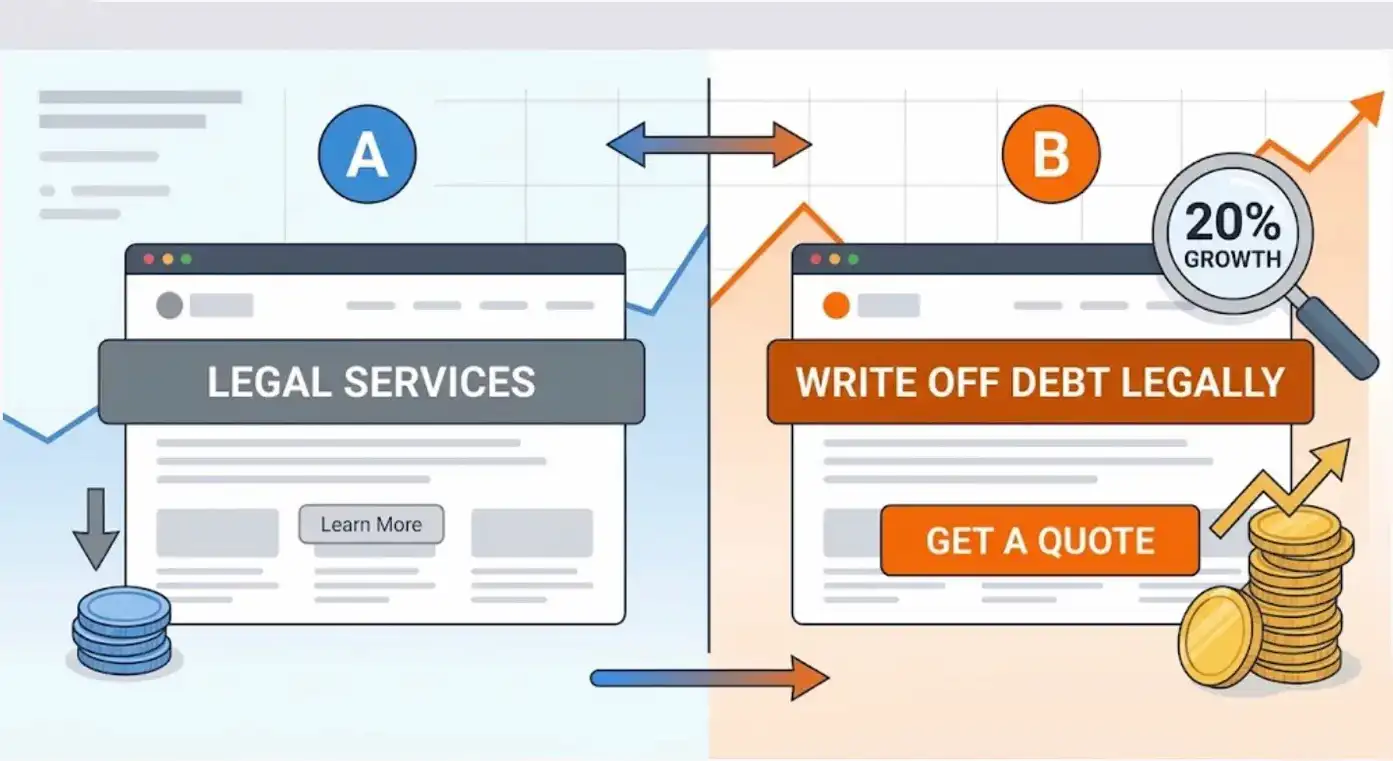
- Before: "Legal Services in London."
- Hypothesis: Clients don't want a lawyer; they want their problem solved.
- After: "Write off credit debts legally in 3 months, or get your money back."
2. The Call to Action (CTA)The text on the button decides the fate of the click.
- Before: "Register" (Boring, obligating, scary).
- Hypothesis: Reduce the stress of decision-making.
- After: "Try for Free" or "Get an Estimate via WhatsApp."
3. The Hero ImagePeople are visual creatures. An image is processed faster than text.
- Before: A stock photo of men in suits shaking hands.
- Hypothesis: Show the real product or the final result.
- After: A video of your work process or a photo of a happy client holding your product.
Part 4. The Step-by-Step Testing Algorithm
Don’t just launch a test blindly. Follow this algorithm to avoid wasting time.
- Step 1. Formulate a Hypothesis: Not "let's change the color." But rather: "If we change the 'Buy' button to 'Try on Online', conversions will grow because clients are afraid of choosing the wrong size."
- Step 2. Check Your Traffic Volume: A/B testing is math. You need statistical data. If you have 50 visitors a day, forget about A/B testing; you’ll wait a year for results. Minimum threshold: at least 1,000 visits to the tested page per week.
- Step 3. Launch and... Don't Breathe: The most common mistake is "peeking." You launch the test in the morning. By noon, Variant B is winning 5 to 2. You celebrate, stop the test, and declare a winner. This is a fatal error. With small numbers, anything can happen. You must wait for Statistical Significance (usually 95% confidence). Do not touch anything until the tool confirms it.
- Step 4. Analyze and Implement: If the test succeeds, roll out the winning variant to 100% of your audience. If it fails (the new variant performed worse), celebrate! Yes, celebrate. You just saved your company money by not implementing a failed idea that would have killed sales. A negative result in an A/B test is still a highly valuable result.
Part 5. Dangerous Traps: How Not to Fool Yourself
- Trap 1. Testing Everything at Once: You changed the headline, the image, and the button all at once. Sales went up. Question: Why? Maybe the headline worked perfectly, but the image actually hurt conversions?
- Rule: In a classic A/B test, change only ONE element at a time. Testing combinations is called Multivariate Testing (MVT) and requires 10x more traffic.
- Trap 2. Seasonality: You ran Variant B during Black Friday, and it showed massive sales. Conclusion: Variant B is brilliant? Reality: No, there was just a huge sale.
- Rule: Tests must run parallel (50/50 traffic split at the exact same time), never sequentially (one week for A, next week for B).
- Trap 3. Ignoring Macro-Conversions: Sometimes a new headline gets more clicks on a button (Leads), but those leads turn out to be garbage and never buy. Always track the final revenue if you have closed-loop analytics.
Conclusion
A/B testing is the only way to find out the truth about your website. Your site is never truly "finished." It is a living organism that constantly needs to be "healed" and trained.
Start small. Stop making bets with your colleagues based on opinions, and bet on an A/B test instead. Take the weakest headline on your site, invent a bold alternative, and run some traffic to it.
The numbers will surprise you.
Read new articles:





Рентабельные рекламные кампании в Яндекс.Директ
Настроим и будем вести контекстную и таргетированную рекламу для вашего бизнеса
Создадим систему привлечения новых клиентов
Уменьшим цену входящего звонка и заявки
Увеличим заказы на маркетплейсах: Ozon, Yandex Market, WB
Подготовим понятные отчеты и аналитику