
Webflow vs Framer in 2026: Why B2B Brands Need Engineering, Not Just Design

If you spend five minutes on design Twitter or LinkedIn, you might think Framer has completely taken over the web development industry. It’s fast, it’s intuitive, and it allows designers to publish beautiful websites without writing a single line of code.
As a Senior Webflow Engineer, I get asked this question by agency founders and art directors every week: "Why should we hire a Webflow developer when our designers can just build the site in Framer?"
My answer is always the same: It depends on whether you are building a temporary marketing asset or a scalable B2B enterprise infrastructure.
Here is the unfiltered technical truth about Webflow vs. Framer, and why serious B2B brands cannot afford to rely solely on design-first tools.
The Core Difference: Canvas Drawing vs. DOM Engineering
To understand why these platforms yield different results, you have to look at how they treat the web.
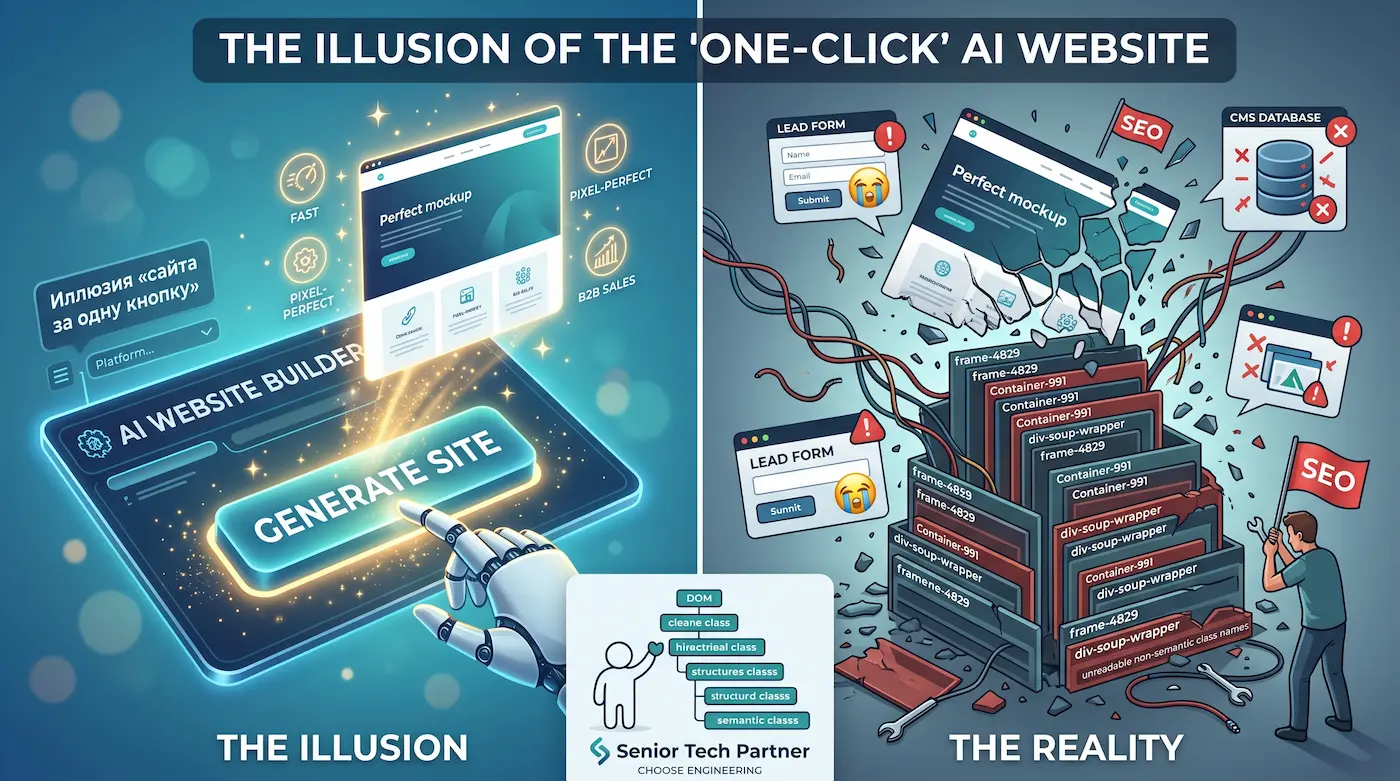
Framer is a design tool that outputs code. It is fundamentally based on a canvas approach. You drag and drop elements freely, much like you do in Figma. Framer then works under the hood to translate your visual layout into React components. It’s brilliant for rapid prototyping and heavily animated portfolio sites.
Webflow is a visual development environment. It does not hide the code from you; it visualizes it. When you build in Webflow, you are strictly interacting with HTML tags, CSS classes, and the DOM (Document Object Model) structure.
Why does this matter to a B2B client?Because when an enterprise client pays $30,000+ for a website, they aren't just buying a pretty interface. They are buying a technical asset that needs to rank on Google, integrate with their CRM (Salesforce, HubSpot), and be maintained by their internal marketing team for years.
1. Code Cleanliness and SEO Performance
Framer relies heavily on React. While React is incredible for building complex web applications (like dashboards), it is often overkill for a static B2B marketing website. Framer sites can carry a heavy JavaScript payload, which can negatively impact Core Web Vitals, specifically your First Contentful Paint (FCP) and Time to Interactive (TTI).
Webflow, when engineered correctly, produces extremely clean, semantic HTML and CSS. As a Webflow Engineer, I can structure the <h1> to <h6> tags logically, optimize semantic tags (<section>, <main>, <nav>), and minimize JavaScript overhead.
For a B2B company competing for high-volume, competitive keywords, this semantic structure is the difference between ranking on page one or page three of Google.
2. The CMS Scalability Problem
Content is the lifeblood of B2B marketing. Your client will eventually need to scale their blog, case studies, team directories, and programmatic SEO landing pages.
Framer’s CMS is functional but basic. It handles simple blogs well, but it struggles with complex, multi-reference relational databases.
Webflow’s CMS is an absolute powerhouse. It allows engineers to build deeply interconnected data structures. You can link a "Case Study" to a specific "Industry", assign multiple "Team Members" as authors, and automatically pull related "Services" into the footer of that specific case study. This level of dynamic content mapping is essential for enterprise scalability.
3. The "Client-First" Handoff
What happens six months after the website goes live, and the client’s internal marketing team needs to add a new section?
Because Framer is so unstructured, a new designer or marketer can easily break the entire layout by dragging an element a few pixels in the wrong direction.
In Webflow, professional engineers use frameworks like Finsweet's Client-First. This means the CSS classes are logically named (e.g., padding-global, text-size-large), and the structure is rigid but scalable. A marketing team can easily duplicate sections, update text, and publish new pages without ever breaking the core design system. The site is engineered to be tamper-proof.
Summary: Which Tool Should You Choose?
- Choose Framer if: You are a freelancer building a personal portfolio, a startup needing a landing page by tomorrow, or an agency focused purely on highly experimental, award-winning visual experiences where SEO and CMS scalability are secondary.
- Choose Webflow if: You are building a complex B2B website, a corporate portal, or a scalable SaaS marketing site. You need flawless SEO, a robust CMS, and clean, hand-off-ready architecture.
Design is only the first step. Engineering is what makes it profitable.
Are you an agency struggling to translate your complex Figma designs into scalable, high-performance websites? Don't leave your clients' technical foundation to chance. Send me a DM or book a technical consultation, and let's discuss how a dedicated Tech Partner can elevate your web deliverables.
Читайте по теме:
Webflow или WordPress: честное сравнение для бизнеса
Webflow для корпоративных сайтов: Почему крупные компании уходят с WordPress и Bitrix?
Webflow, Tilda или WordPress: На чем строить сайт. Честное сравнение CMS.
1С-Битрикс или современный стек: почему бизнес переплачивает за «монстра»?
Read new articles:









Рентабельные рекламные кампании в Яндекс.Директ
Настроим и будем вести контекстную и таргетированную рекламу для вашего бизнеса
Создадим систему привлечения новых клиентов
Уменьшим цену входящего звонка и заявки
Увеличим заказы на маркетплейсах: Ozon, Yandex Market, WB
Подготовим понятные отчеты и аналитику