
The "One-Click" Illusion: Why AI Website Generators Will Never Replace Senior B2B Web Engineers

"Just type a prompt, and our AI will generate a complete website for your business in 30 seconds!"
The marketing banners for AI website builders sound like a death sentence for the web development profession. They create a dangerous illusion for B2B founders: the belief that they can entirely skip the engineering phase, get a working product for free, or drastically slash a developer's budget under the assumption that the developer is just using the same AI tool.
If you need a disposable, one-day landing page for a local bake sale, this approach might work. But when it comes to serious enterprise B2B, attempting to generate your digital architecture with an AI prompt guarantees a technical dead-end, destroyed organic traffic, and a leaky sales pipeline.
Let’s look under the hood of these "one-click websites" and break down exactly why manual engineering remains completely irreplaceable.
1. "Statistically Average" Design & Lost Positioning
AI does not create anything fundamentally new. It aggregates and analyzes millions of existing templates in its training data and spits out a "statistically average" solution.
The result? You get a sterile, generic, and completely soulless layout that does absolutely nothing to communicate your Unique Selling Proposition (USP). In the highly competitive B2B sector, where you are fighting for trust and authority, an average design means you are entirely forgettable. The enterprise buyer will simply close the tab and go to a competitor with a custom-engineered, thoughtful UX.
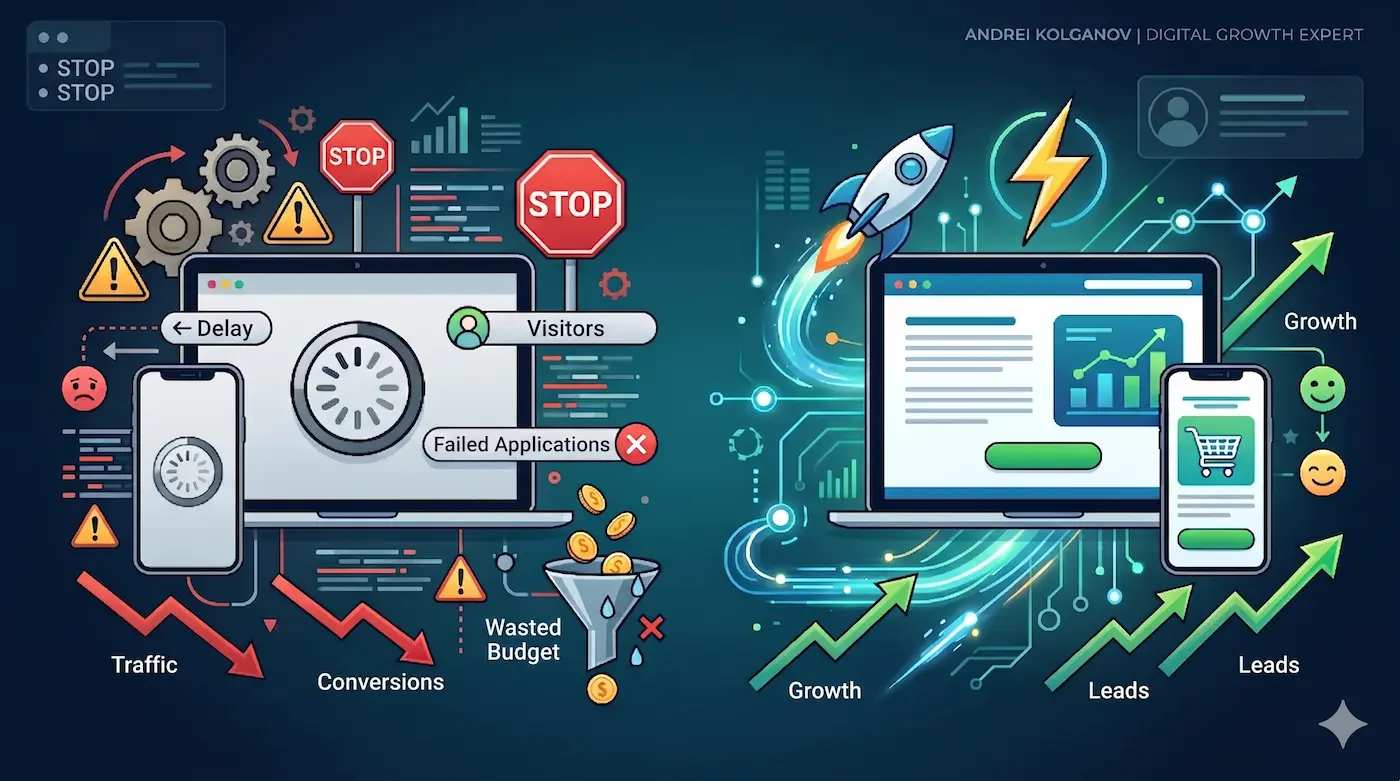
2. Spaghetti Code and Core Web Vitals Failure
A visually acceptable picture generated by AI often hides an absolute technical nightmare underneath. AI algorithms stitch pages together using disjointed, bloated blocks of code.
- Unoptimized DOM: The code is packed with redundant JavaScript, unnecessary CSS stylesheets, and hidden
divblocks. - Zero Maintainability: If a specific element breaks on a certain mobile device, you cannot dive into the code to quickly fix a CSS class. The architecture is either completely closed off or an unreadable mess.
- The SEO Penalty: Search engines like Google aggressively penalize slow websites with dirty code. AI-generated sites routinely fail Google’s Core Web Vitals and PageSpeed Insights tests, instantly killing your chances of ranking in organic search.
3. Broken Lead Capture & CRM Isolation
The sole purpose of a B2B website is to convert traffic into qualified pipeline. This is exactly where AI builders expose their fatal weakness. Generated lead forms are rigid and often function poorly:
- You cannot engineer complex, multi-step forms (progressive profiling) with conditional logic.
- You cannot natively integrate the form with custom enterprise CRMs (like Salesforce or custom HubSpot pipelines) via secure webhooks.
- Leads are often trapped inside the AI platform’s internal, clunky dashboard. If you do not control your lead data routing, you do not control your sales.
4. The Absence of Relational CMS Architecture
AI generators output static web pages. If your B2B marketing strategy requires a corporate blog, a catalog of 500 enterprise services, or a dynamic database of case studies, you absolutely need a relational database (CMS)—like the one natively built into Webflow.
Current AI platforms are incapable of architecting logical relationships between database tables (Reference Fields). Scaling an AI-generated site is practically impossible: adding a new service or publishing an article becomes a manual, painful, and repetitive chore.
5. Digital Hostage-Taking (Vendor Lock-in)
You do not own the website generated by an AI service. You are simply renting space on their servers.
- You cannot export the clean HTML/CSS/JS source code.
- You cannot host the website on your own secure AWS servers for enterprise compliance.
- If the AI platform shuts down tomorrow or triples its monthly pricing, you lose your entire digital asset overnight.
Professional engineering (including enterprise Webflow development) always provides the ability to export your code, giving the business total ownership and control over its digital assets.
Summary: AI is a Copilot, Not an Autopilot
Does this mean neural networks are useless in web development? Absolutely not. AI is a phenomenal tool for preliminary architectural brainstorming.
Generating a rough landing page structure, assembling a mood board, mapping out a low-fidelity wireframe, or drafting placeholder copy—AI is perfect for these tasks.
But transforming that rough sketch into a lightning-fast, high-converting, infinitely scalable digital product with pristine code architecture and custom database integrations? That is still the exclusive domain of a Senior Web Engineer.
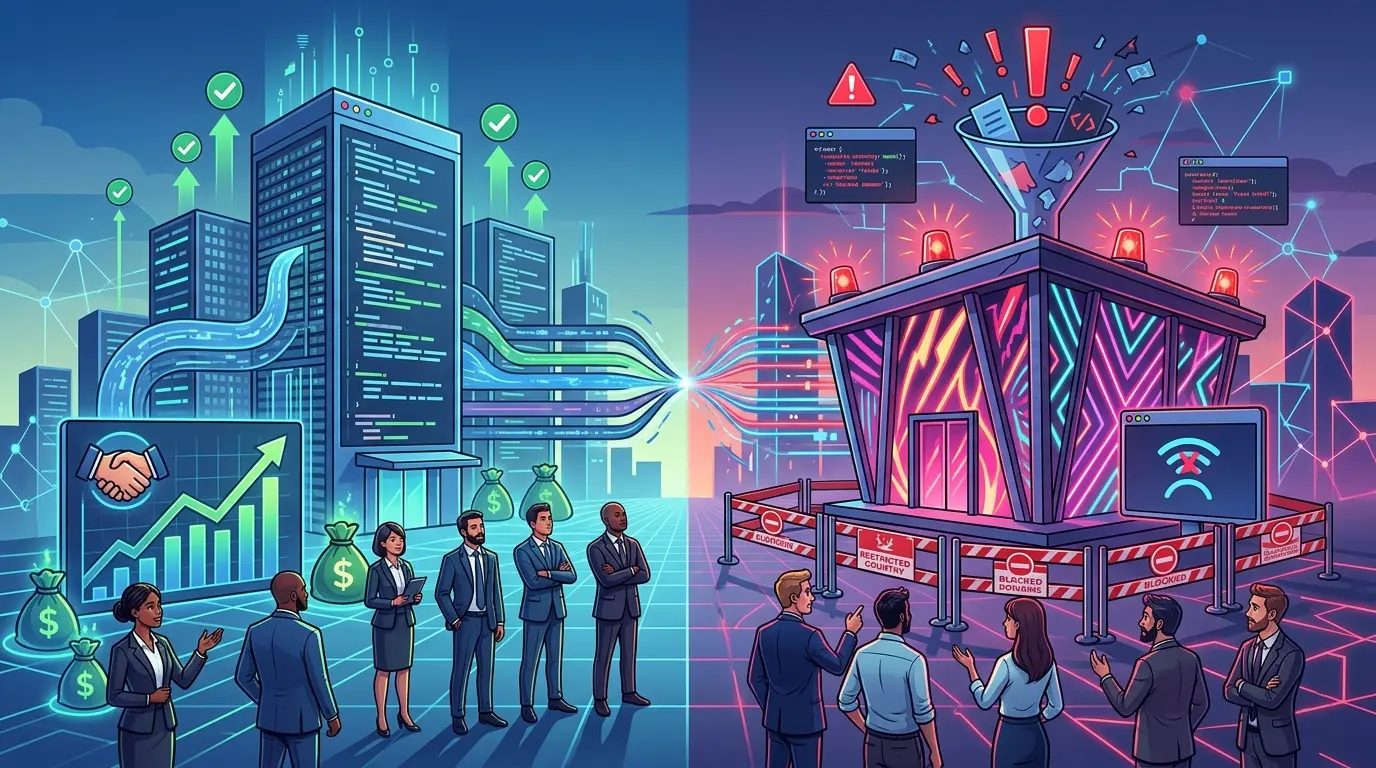
Do not confuse a quick sketch with a stable skyscraper.
Read new articles:






Рентабельные рекламные кампании в Яндекс.Директ
Настроим и будем вести контекстную и таргетированную рекламу для вашего бизнеса
Создадим систему привлечения новых клиентов
Уменьшим цену входящего звонка и заявки
Увеличим заказы на маркетплейсах: Ozon, Yandex Market, WB
Подготовим понятные отчеты и аналитику