
Multilingual Webflow Sites: Scaling Globally Without the Technical Chaos
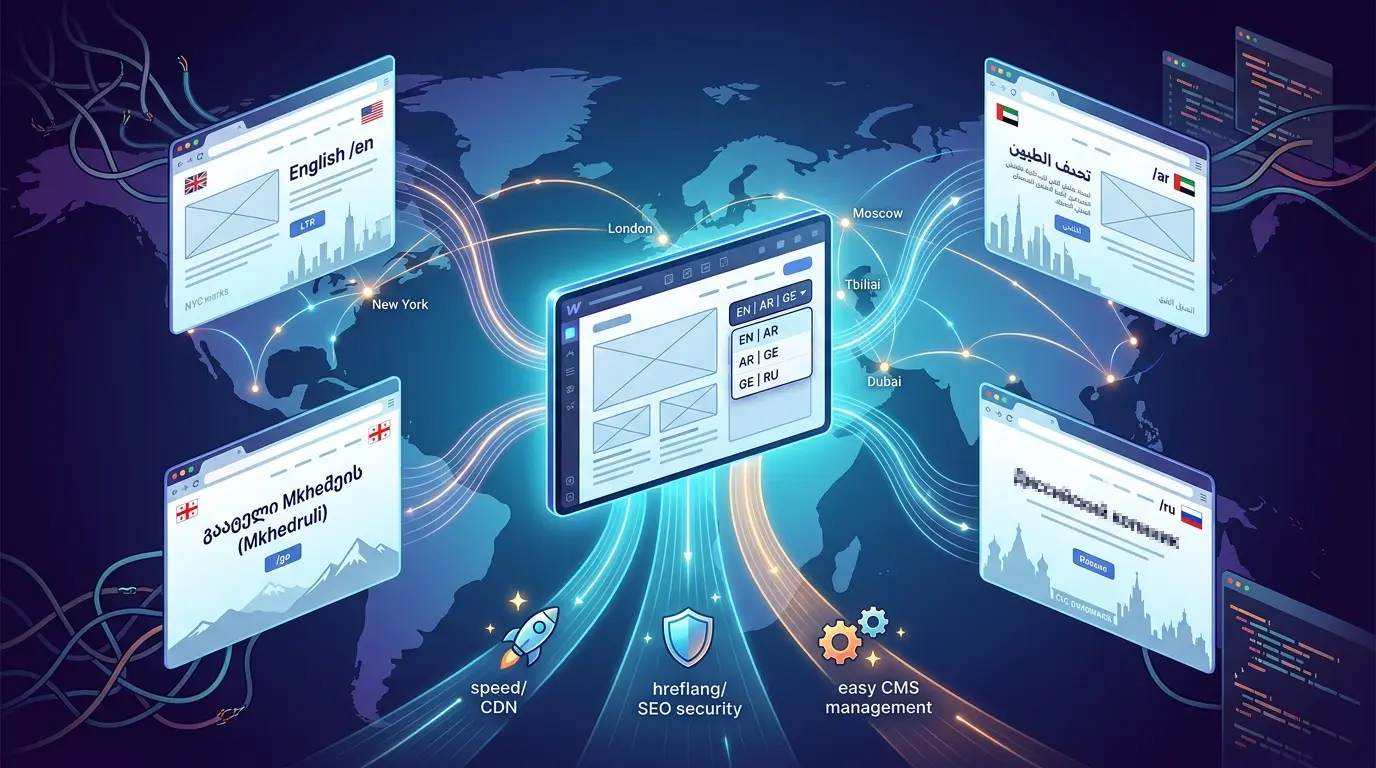
In 2026, business borders are purely digital. A SaaS company in London targets the US market, while a European enterprise expands into APAC. In this race, your website is the primary vehicle for global expansion.
However, many B2B brands make a critical architectural mistake: they simply bolt on a cheap "translation widget" that breaks the DOM structure, ruins the layout, and delivers broken grammar. For a serious business, this approach is reputational suicide. True international scaling requires native, engineered Localization.
Webflow offers one of the most elegant enterprise solutions for building multilingual architectures. Here is a technical breakdown of how it works and why it makes perfect business sense.
1. Native Webflow Localization: Architecture, Not Band-Aids
For years, building a multilingual Webflow site required third-party javascript workarounds (like Weglot). But with Webflow’s native Localization module, the paradigm has shifted from "translating over the top" to "building from within."
The Engineering Advantages:
- Visual DOM Customization: You are not just replacing text. You can completely alter images, hide specific sections, or restructure the layout for a specific region. For example, the Middle Eastern market might require a stricter visual hierarchy, while the US market demands highly dynamic layouts.
- Independent Routing: Each locale gets its own logical subdirectory (e.g.,
/en,/de,/ar). This is critical for search engines to map and understand your site's regional architecture properly.
2. Enterprise-Grade Technical SEO
Entering the US or European market means stepping into a highly competitive Google landscape. A poorly translated site won't even be indexed properly. For international SEO, Webflow natively handles the heaviest technical lifting:
- Automated Hreflang Attributes: These are specialized HTML tags that tell search engines: "This Spanish content is for Mexico, and this version is for Spain." Webflow generates these automatically, eliminating the risk of duplicate content penalties.
- Global AWS Edge Network: If you want a user in New York to experience the same instant First Contentful Paint (FCP) as a user in Berlin, your assets must be physically close to them. Webflow distributes your localized site across Amazon Web Services (AWS) nodes globally, ensuring millisecond latency anywhere in the world.
- Localized Meta Data: Titles, descriptions, and Open Graph tags are decoupled and managed per locale, allowing you to target hyper-local search intent.
3. Cultural UX and Semantic Adaptation
Localization is not translation; it is the adaptation of meaning and user experience.
- Currencies and Formats: Dynamic pricing requires precision. One version displays dollars with a dot; another displays euros with a comma.
- Conversion Logic: Different countries use different standards for phone numbers, addresses, and compliance (like GDPR). Webflow allows engineers to configure forms and data-capture logic individually per region.
- Typography Fallbacks: Not all premium typefaces support complex character sets. As a Tech Partner, I ensure the typography stack is engineered with solid fallbacks so the brand looks premium, whether it's rendered in English, German, or Arabic.
4. Centralized CMS Architecture
The biggest nightmare for an enterprise scaling globally is fragmented databases. On Webflow, you manage all regions from a single source of truth.
Your content team logs into the familiar Editor, switches the locale, and inputs the translation. Thanks to data inheritance, if you add a new Case Study or Product to the primary locale, the database architecture automatically generates the corresponding pages across all localized versions. You only need to populate the text. This eliminates dozens of hours of redundant development overhead every month.
5. The Economics of Global Scaling
The traditional enterprise route—building separate websites on separate domains or fragmented WordPress instances—exponentially multiplies your hosting, maintenance, and team costs.
The engineered Webflow approach allows you to:
- Lower Total Cost of Ownership (TCO): One project, one subscription, one unified database.
- Accelerate Time-to-Market: Launching a new region (e.g., adding a French locale) takes days, not months of new development.
- Enforce Brand Consistency: You guarantee your design system remains pixel-perfect across Europe, Asia, and the Americas without code divergence.
Summary
Global expansion is a high-stakes game. Your website is your digital embassy. If it loads slowly, displays broken layouts, or feels like a cheap machine translation, you immediately lose the trust of enterprise decision-makers.
By combining Webflow Localization with flawless engineering, you get a powerful, scalable asset ready for global competition from day one.
Stop losing international leads to fragmented tech stacks. If you are a design agency or a B2B brand looking to scale across borders without the technical chaos, send me a DM or book a technical consultation. Let's architect your global digital presence the right way.
Read new articles:







Рентабельные рекламные кампании в Яндекс.Директ
Настроим и будем вести контекстную и таргетированную рекламу для вашего бизнеса
Создадим систему привлечения новых клиентов
Уменьшим цену входящего звонка и заявки
Увеличим заказы на маркетплейсах: Ozon, Yandex Market, WB
Подготовим понятные отчеты и аналитику