
Webflow for Enterprise: Why Global B2B Brands Are Abandoning WordPress and Legacy CMS
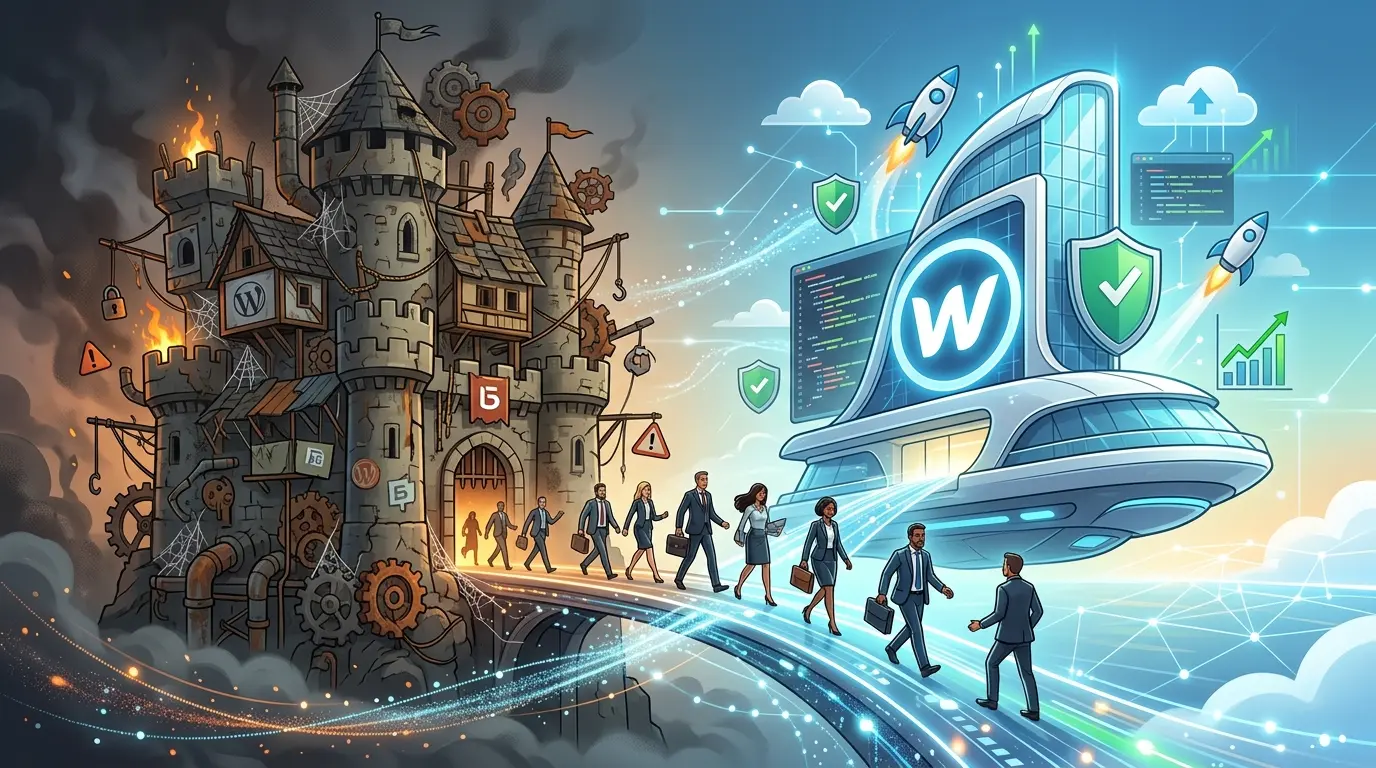
For over a decade, the corporate web development market was dominated by heavyweights: WordPress, Drupal, and complex legacy CMS platforms. The standard assumption was that if you needed a serious B2B website, complex catalog, or corporate portal, you had to endure convoluted backend architecture and keep a full-time team of PHP developers on a costly retainer.
In recent years, that paradigm has shifted entirely. Global enterprises, tech startups, and top-tier design agencies are increasingly migrating their infrastructure to Webflow.
Why is this happening? It’s not just a trend toward "no-code." It is a pragmatic business calculation where security, performance, and Total Cost of Ownership (TCO) are on the line.
As a Senior Webflow Engineer, I audit corporate websites daily. Here is the technical truth about why legacy CMS platforms are losing the enterprise market.
1. The "Technical Debt" of Plugin Architectures
The fundamental flaw of WordPress and similar legacy systems is their absolute reliance on third-party plugins. To build a modern corporate site on WP, developers are forced to patch together dozens of extensions: one for SEO, one for caching, one for forms, and one for security.
This creates a highly unstable architectural "Frankenstein":
- Update Conflicts: Update one plugin, and the entire layout breaks.
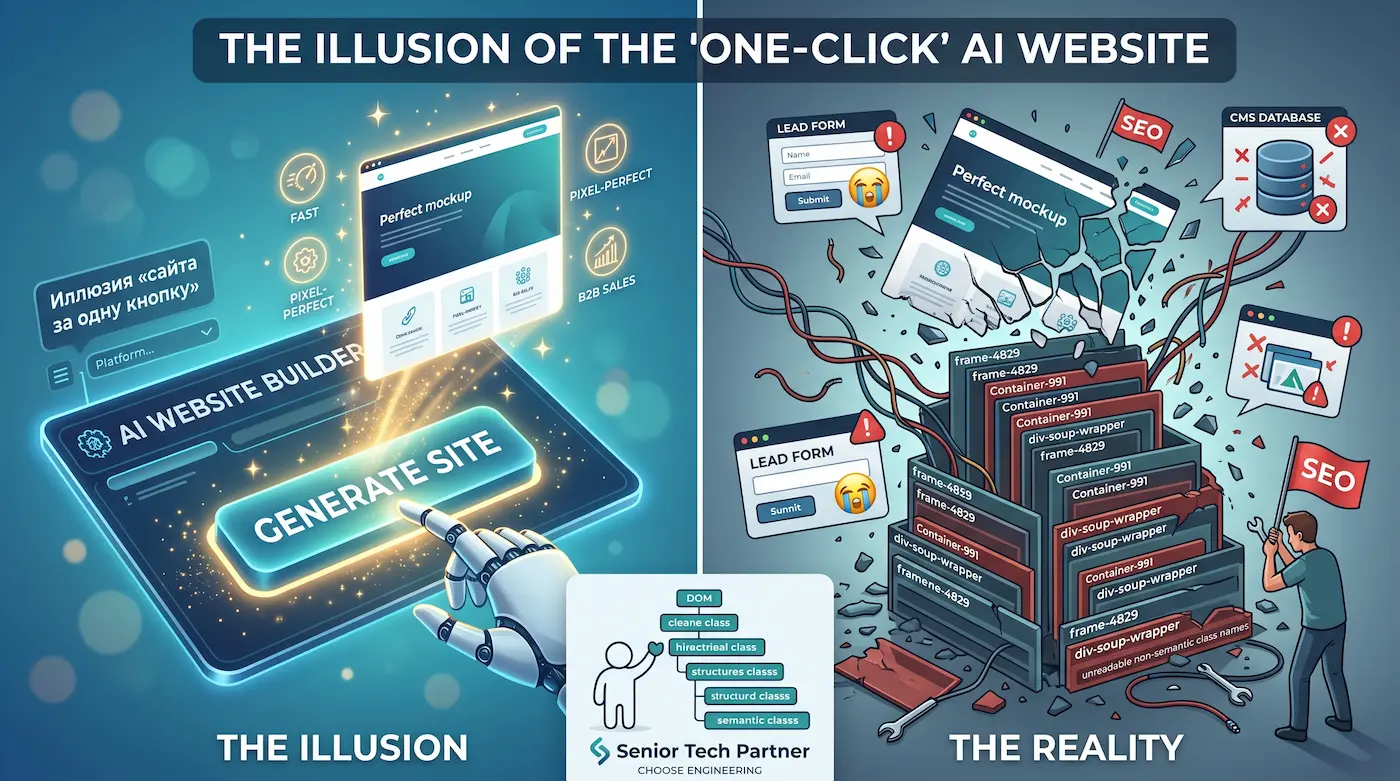
- The "Div-Soup" Problem: Every plugin injects its own render-blocking JavaScript and redundant CSS styles, resulting in a bloated DOM structure that cripples loading speeds.
- Security Vulnerabilities: Over 90% of WordPress hacks occur through vulnerabilities in third-party plugins, not the core system.
In Webflow, the core functionality (Forms, SEO, CMS, Animations) is natively built into the engine. This is a Clean Code architecture that doesn't require third-party crutches to function properly.
2. Enterprise Security: Ending the Update Nightmare
For the B2B and enterprise sectors, data security is Priority #1. In Open Source systems, your client data is perpetually in the crosshairs. You have to constantly monitor PHP versions, update the core engine, and patch plugins—fail to do so, and your corporate site becomes part of a botnet.
Webflow engineers approach security differently:
- Closed Ecosystem: Hackers do not have access to the server's source code or database vulnerabilities.
- AWS Enterprise Hosting: Sites are hosted on Amazon Web Services (AWS) with military-grade, built-in DDoS protection and automated SSL certificates.
- Zero Manual Maintenance: The platform updates continuously on the server side. You are always running the latest, most secure version without the risk of your website crashing on a Monday morning.
3. Google Core Web Vitals and Ad Performance
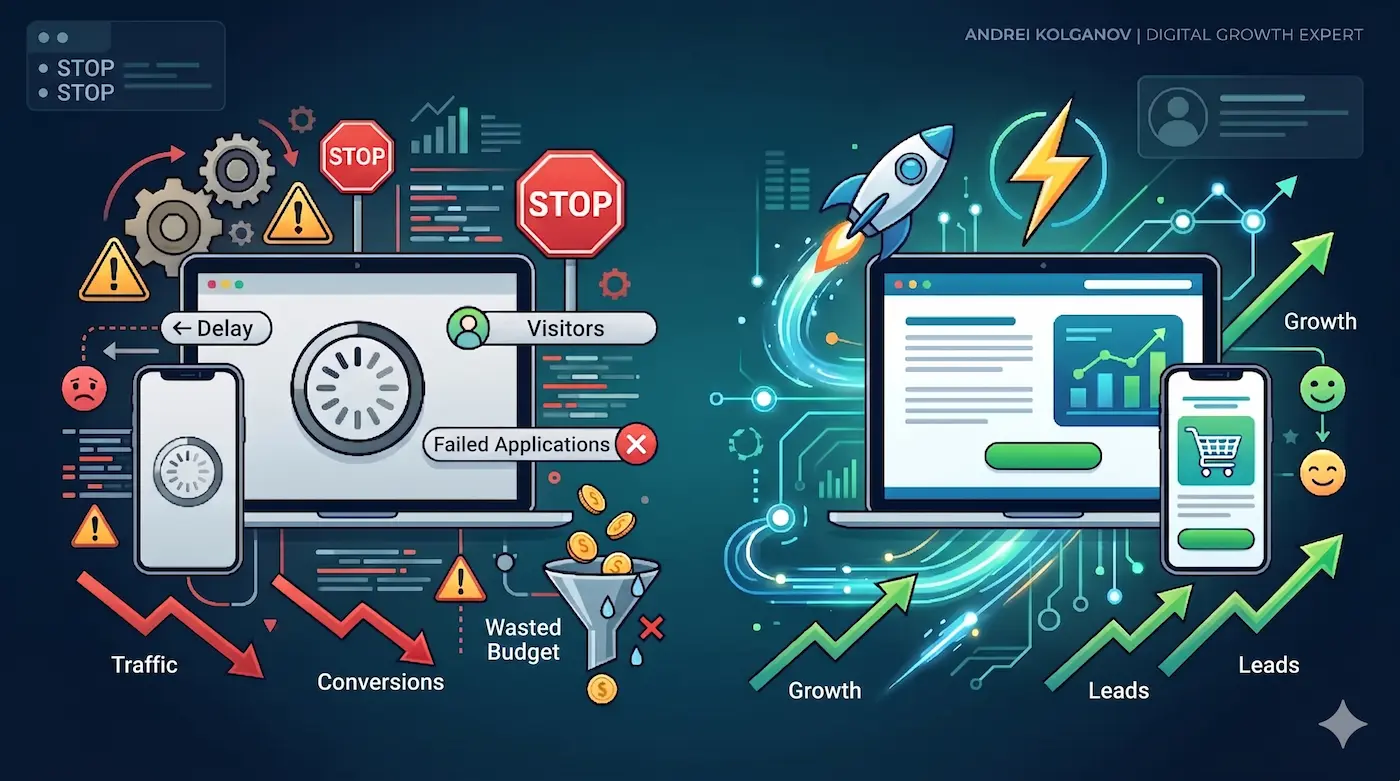
Google has explicitly made loading speed and rendering stability (Core Web Vitals) a primary ranking factor. Corporate sites on legacy CMS platforms often resemble overloaded freight trucks: they might hold a lot of data, but they accelerate incredibly slowly due to heavy database queries.
Webflow generates pristine, semantic HTML, CSS, and JS. This allows custom-engineered sites to achieve 90+ scores in Google PageSpeed Insights "out of the box."For a B2B company, this means:
- Lower Cost-Per-Click in Google Ads: Google rewards fast, optimized landing pages with a higher Quality Score, directly lowering your ad spend.
- Higher Organic Rankings: Search engines prioritize websites with instant First Contentful Paint (FCP) metrics.
- Zero Lead Drop-off: B2B decision-makers on mobile devices experience instant load times, drastically reducing bounce rates.
4. A CMS Built for Marketers, Not Programmers
The classic corporate bottleneck: the marketing team wants to change a headline or add a new service, but they have to submit a Jira ticket to the development team and wait a week.
The Webflow Editor fundamentally changes this workflow. Your content team logs into a secure, visual interface that looks exactly like the live website.
- Need to add a new Case Study? 2 minutes.
- Need to update pricing in the catalog? 1 minute.
Most importantly, the Editor securely decouples the content from the DOM structure. Your marketing team can edit text and swap images, but they are physically prevented from "breaking" the engineered design system.
5. Total Cost of Ownership (TCO): The Hidden Retainers
Clients often fixate on the initial cost of development but completely ignore the Total Cost of Ownership (TCO) over a 3-to-5-year cycle.
- Legacy CMS: You are paying for a system administrator, premium managed hosting, annual licenses for premium plugins, and a monthly developer retainer just for "maintenance and security patches."
- Webflow: You pay a single, predictable SaaS subscription that includes enterprise-grade AWS hosting, global CDN distribution, and infinite security updates. In the long run, Webflow is drastically more cost-effective because it eliminates the need for constant "repair work."
6. Figma-to-DOM Translation Without Compromise
In traditional development workflows, an art director creates a stunning, complex design in Figma. The backend developer looks at it and says, "That’s too hard/expensive to code." The result is a watered-down, compromised website that looks cheap.
Webflow is a visual development environment. It allows Senior Engineers to translate complex Figma designs and custom micro-interactions directly into pixel-perfect code, 1-to-1. For global brands that need to project technological superiority and premium status, this lack of compromise is critical.
Summary: Is It Time to Migrate?
Migrating to a modern tech stack is not just about changing your CMS; it is an investment in a high-performance marketing asset that works for your business, rather than requiring your business to constantly work on it.
Webflow is the definitive choice for corporate architectures, complex B2B catalogs, and high-conversion landing pages if you:
- Are exhausted by the slow performance and constant technical glitches of your current CMS.
- Want to give your marketing team total content autonomy without developer bottlenecks.
- Demand enterprise-grade security without paying for endless maintenance retainers.
- Need a flawless technical foundation for SEO and aggressive performance marketing campaigns.
Stop losing B2B leads to technical debt. Send me a DM or book a technical consultation to discuss migrating your legacy infrastructure to a scalable Webflow architecture.
Read new articles:





Рентабельные рекламные кампании в Яндекс.Директ
Настроим и будем вести контекстную и таргетированную рекламу для вашего бизнеса
Создадим систему привлечения новых клиентов
Уменьшим цену входящего звонка и заявки
Увеличим заказы на маркетплейсах: Ozon, Yandex Market, WB
Подготовим понятные отчеты и аналитику