
SGE SEO Guide: Adapting to AI Overviews in 2026

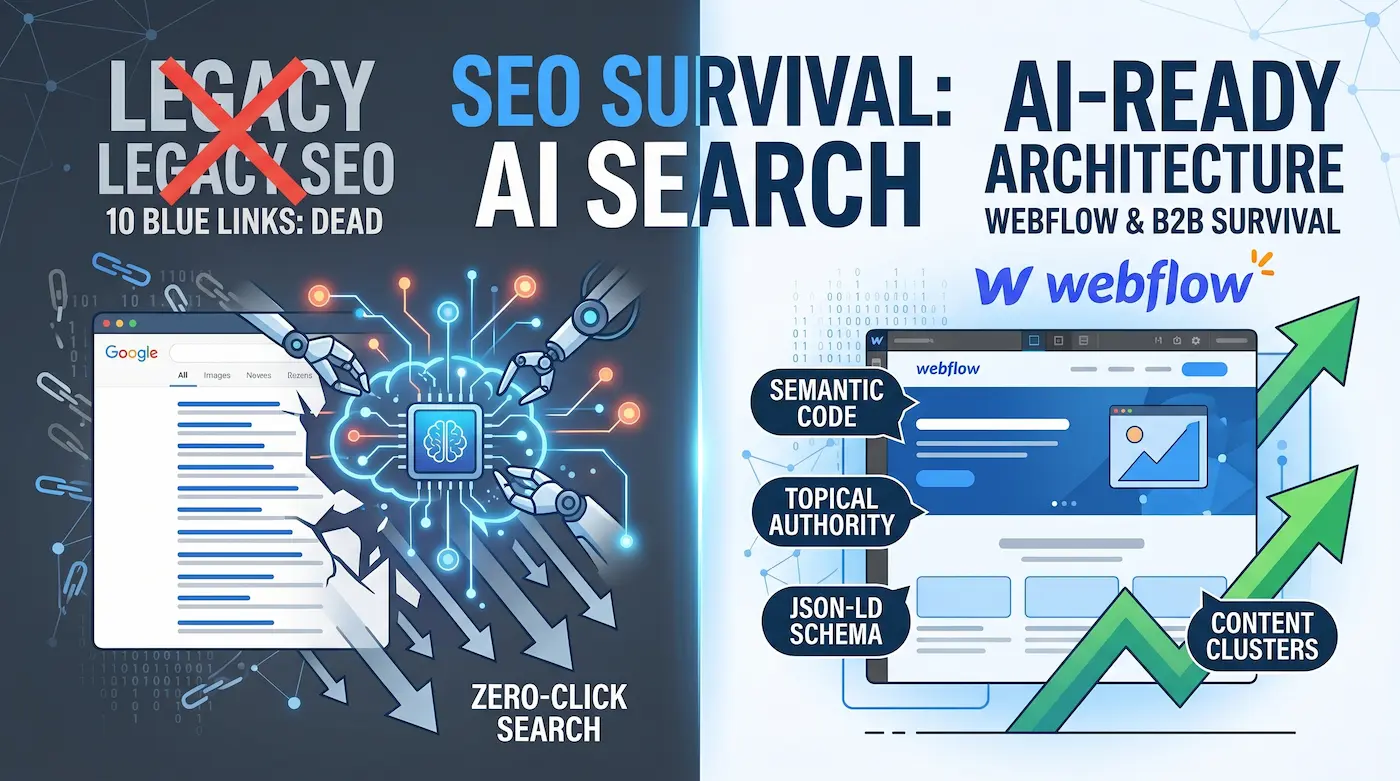
Remember the panic of 2023–2024 when Google first announced the Search Generative Experience (SGE)? Marketers predicted the death of organic traffic, the "end of the 10 blue links era," and total AI domination.
Fast forward to 2026. SEO isn't dead, but it has mutated. We now call it AIO (Artificial Intelligence Optimization) or GEO (Generative Engine Optimization).
Today, Google isn't just a librarian pointing you to a bookshelf of links. It’s an assistant that has already read those books and gives you the answer directly. If your website isn't featured in the AI Overviews generated by Gemini, you're losing up to 40% of potential mobile traffic.
In this guide, we'll break down how to restructure your SEO strategy to appeal to Gemini's algorithms, secure a spot in that coveted block above the search results, and convert that visibility into actual leads.
What are AI Overviews and How Do They Work in 2026?
AI Overviews (formerly SGE) is a block at the top of the search results where the neural network (Google's Gemini) generates a coherent, synthesized answer to a user's query by pulling information from multiple sources.
The key difference from old SEO: Google used to search for keywords. Now, Google searches for meaning and facts.
The algorithm operates on the RAG (Retrieval-Augmented Generation) principle. It:
- Understands Intent: What does the user actually want? (To buy, learn, compare, or get advice).
- Retrieves Facts: Scans the top 10 to 20 search results.
- Synthesizes the Answer: Writes unique text, placing footnote links to the original sources.
Your ultimate goal is to become the exact source that the neural network decides to cite.
Strategy 1: Information Gain
In an era of AI content generated by other AI, Google has aggressively started filtering out rewritten material. If your article simply repeats what your competitors have said using different words, Gemini will ignore it. It doesn't need 10 identical answers.
What is Information Gain? It’s the unique value your content adds to the overall knowledge base of a specific topic. To make it into the AI Overview, you must provide what others lack.
How to increase Information Gain:
- Original Research and Data: Conduct a survey of 50 clients and publish the numbers. AI algorithms love raw data and statistics.
- Personal Experience (E-E-A-T): Neural networks can hallucinate, but they lack a physical body and real-world experience. Phrases like "We tested this tool on a project with a $50k budget, and here is what happened..." act as a magnet for AI.
- Unconventional Angles: While everyone else writes "How to choose a CRM," you should write "Why CRM implementations fail 90% of the time."
Strategy 2: Content Structure for "Machine Reading"
Gemini is a robot. It struggles to wade through convoluted metaphors and massive walls of text. To be selected for generation, your content must be structured like a clean database.
The "Question — Direct Answer" Principle
AI frequently pulls text snippets that concisely answer a specific query.
- ❌ Bad (Fluff): "Many people wonder how much development costs, and this question depends on a multitude of factors..."
- ✅ Good (Direct): "The cost of developing a corporate website in 2026 ranges from $3,000 to $15,000. Key pricing factors include CRM integration, animation complexity, and the total number of pages."
Pro Tip: Use lists, bullet points, and clear definitions extensively.
Strategy 3: Technical Optimization and Schema.org
If an AI cannot figure out what your page is about in 0.5 seconds, it skips it entirely. In 2026, technical SEO is the language of robots.
Structured Data (Schema Markup)
This is no longer just a recommendation; it is a strict requirement. You must mark up everything using the JSON-LD format:
Article: For blog posts and news.FAQPage: For Q&A sections (AI loves pulling direct answers from here).Product: For e-commerce items (price, availability, reviews).Organization: To link your brand directly with its services.
The more microdata you implement, the easier it is for Gemini to break your content down into "atoms" and reassemble them into a user-facing answer.
Speed and Accessibility
Core Web Vitals still matter. AI processes billions of pages daily. Heavy websites that take 5 seconds to load receive a very low crawl priority for generating Real-time answers.
Strategy 4: Optimizing for Zero-Click and Long-Tail Queries
The main problem with SGE is that users get their answers right on the search page and may never click through to your website. This is known as Zero-Click Search. Here is how you combat it:
1. Optimize for "Complex Questions"
AI is flawless at answering simple questions ("How old is the President?" or "Capital of Australia"). Organic traffic for these queries is dead. Instead, focus on queries that require opinion, nuance, or complex instructions.
- Instead of: "iPhone 18 price"
- Write: "iPhone 18 vs. Samsung S27 camera comparison for night photography: Real test"
2. Create "Hooks" (Click Incentives)
An AI Overview usually features 3 to 5 source links in a carousel. To ensure users click on your link:
- Use provocative or highly specific Titles.
- Offer downloadable materials, templates, calculators, or deep analytics that the AI cannot fully replicate in a brief snippet.
- Use high-quality image thumbnails, as they are frequently pulled into the AI Overview UI.
How to Track Performance in AIO?
Google Search Console has evolved by 2026, but classic metrics require a shift in perspective:
- A dropping CTR is normal: If you see a decline in click-through rates for informational queries, don't panic. That's the SGE effect. Look at your conversion rates instead. The users who do click through are now a much "warmer," higher-intent audience.
- Growth in Branded Queries: If AI consistently cites you as an expert, people will start Googling your company name directly. This is the most valuable type of traffic you can get.
- Position matters less: You might be ranking #4 in the standard organic results, but if you are featured in the AI snapshot at the very top, you are functionally outperforming the #1 spot.
Conclusion: Adapt or Fade Away
AI Overviews are not website killers; they are filters. They aggressively weed out mediocre, rewritten content and highlight creators who genuinely understand their subject matter.
To survive in the SEO landscape of 2026, the formula boils down to one simple rule: Be the source, not the middleman.
Create content that the neural network will want to cite as proof of its accuracy. Invest in your authors' personal brands, publish unique data, and get your site's technical backend into pristine condition.
Need help adapting your website to Google Gemini’s modern requirements? We conduct deep content and technical SEO audits. Reach out to us today to ensure your business doesn't get left behind in the evolution of search.
Read new articles:








Рентабельные рекламные кампании в Яндекс.Директ
Настроим и будем вести контекстную и таргетированную рекламу для вашего бизнеса
Создадим систему привлечения новых клиентов
Уменьшим цену входящего звонка и заявки
Увеличим заказы на маркетплейсах: Ozon, Yandex Market, WB
Подготовим понятные отчеты и аналитику