AIO (AI Optimization): How to Engineer Your B2B Website for Google AI Overviews in 2026

The Era of "Ten Blue Links" is Officially Dead
Today’s B2B buyer does not want to open five different browser tabs to piece together an answer to a complex technical question. They want it instantly, summarized by Google’s AI Overviews (SGE), Perplexity, or ChatGPT.
For many founders, this sounds terrifying: "If the AI answers the user's question directly on the search page, why would anyone ever click through to my website?"
The answer is simple: Trust and Validation. For an LLM (Large Language Model) to generate that answer, it must pull data from a trusted, perfectly structured source. We are officially transitioning from traditional SEO (Search Engine Optimization) to AIO (Artificial Intelligence Optimization).
Here is how you engineer your website to become the primary source cited by global AI algorithms.
How AI Agents Choose Their Sources
AI algorithms like Google Gemini do not crawl the web the same way old search bots did. They aren't just looking for keyword density; they are looking for structured semantics and entities. To get cited by an AI, your digital architecture must meet three strict engineering criteria:
1. Flawless Data Structure (Schema.org)
AI models love mathematical clarity. Using JSON-LD microdata is no longer a "nice-to-have" SEO trick; it is a mandatory architectural requirement. You must explicitly "explain" to the machine: This is a pricing table, this is a customer review, and this is a step-by-step FAQ.
- The Engineering Fix: In Webflow, we inject dynamic
JSON-LDscripts directly into the<head>of CMS templates, completely automating semantic markup for hundreds of programmatic pages.
2. The "One Viewport, One Answer" Principle
AI agents scan your DOM (Document Object Model) looking for easily extractable, modular blocks of information. If your H2 heading perfectly matches the user's prompt, and the very next paragraph (or bulleted list) provides a direct, concise answer, your chances of being cited skyrocket.
3. Technical Purity & Rendering Speed
If your website is bloated with heavy JavaScript, legacy WordPress plugins, or aggressive scrolljacking, the crawler will waste its "crawl budget" trying to render the page. An AI agent will simply abandon it and choose a lighter, faster competitor. The clean, semantic code exported by Webflow provides a massive competitive advantage here.
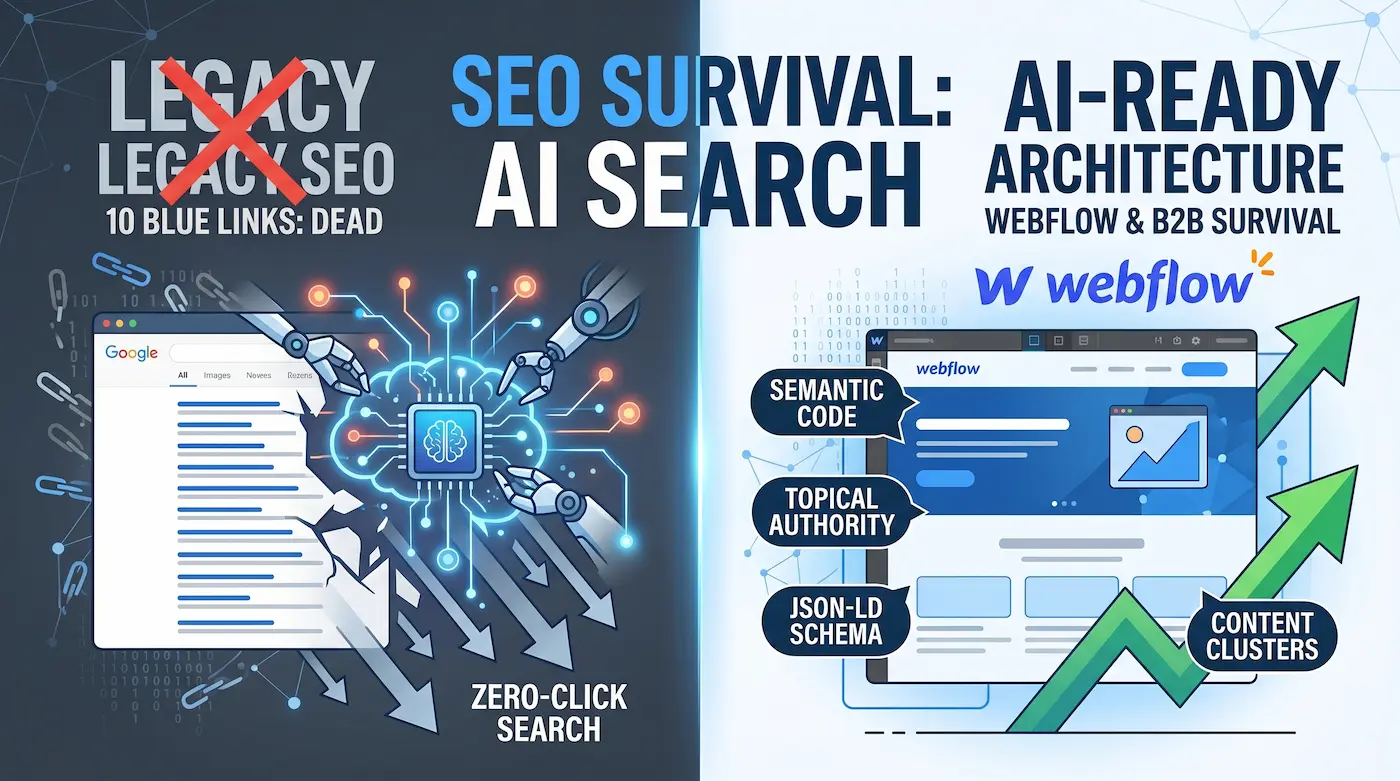
Traditional SEO vs. AI-Ready SEO (AIO)
How to Survive the "Zero-Click" Search Phenomenon
Many marketing directors are terrified that AI will steal their traffic. In reality, AI Overviews generate the highest-intent traffic possible.
If a B2B buyer reads a generated summary and still clicks your citation link, they are incredibly qualified. They aren't clicking just to browse; they are clicking for deep expertise, verifiable case studies, and to book a call.
Our architectural strategy for the AI Era involves:
- Topic Clustering: We build your semantic core around transactional questions: "How to deploy?", "What is the ROI of...?", and "Migration timelines."
- Native FAQ Schema: We engineer dynamic CMS blocks that wrap your answers in machine-readable markup, feeding the AI exactly what it wants to eat.
- Visual Data Anchors: While LLMs are primarily text-based, they heavily weigh HTML tables and engineered Alt-tags. We structure your data so machines can parse it instantly.
Summary
In 2026, SEO is not a battle for keywords; it is a battle for the trust of AI agents. If your B2B website is a legacy "black box" running on an outdated CMS with spaghetti code, you will simply disappear from search results. But if your site is engineered as a transparent, high-speed knowledge base, you will dominate the new era of search.
Is your website architecture ready to be read by Artificial Intelligence? We engineer enterprise sites that Google Gemini and Perplexity love to cite.
Read new articles:






Рентабельные рекламные кампании в Яндекс.Директ
Настроим и будем вести контекстную и таргетированную рекламу для вашего бизнеса
Создадим систему привлечения новых клиентов
Уменьшим цену входящего звонка и заявки
Увеличим заказы на маркетплейсах: Ozon, Yandex Market, WB
Подготовим понятные отчеты и аналитику