
The SEO Apocalypse is Here: How B2B Websites Can Survive Google’s AI-Only Search
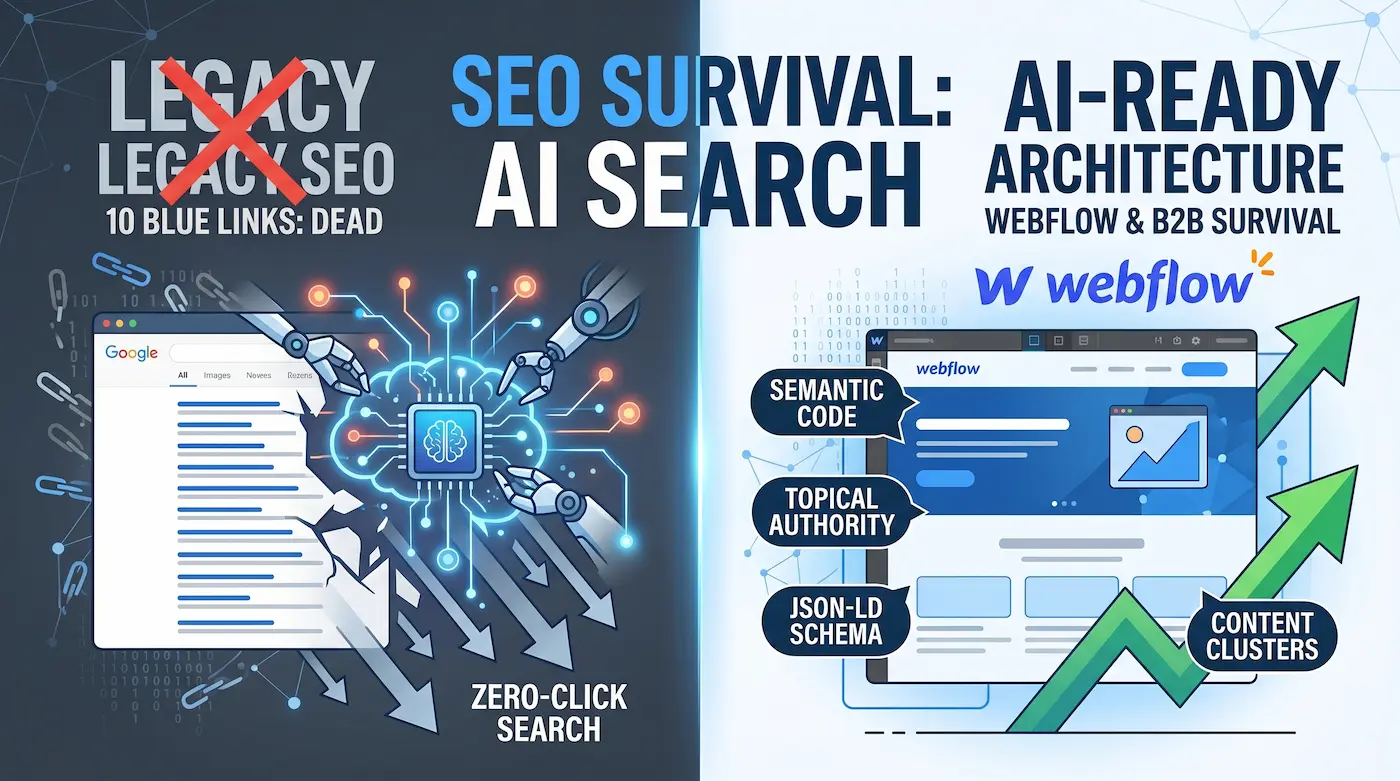
The "10 Blue Links" Are Officially Dead
If you have been following the latest tech news, you likely saw the announcement that sent shockwaves through the digital marketing world: Google is fundamentally changing its search engine. The familiar page of ten blue links is being replaced by a single, comprehensive, AI-generated answer at the top of the screen.
For B2B founders and marketers, this triggers an immediate panic attack: "If Google’s AI gives the user the exact answer right on the search page, why would anyone ever click through to my website? Is my SEO budget completely wasted?"
Welcome to the era of the Zero-Click Search.
The panic is understandable, but it is entirely misplaced. In this article, I will explain why this radical shift is actually the greatest opportunity for serious B2B companies, and exactly how you need to adapt your web architecture to survive it.
The Brutal Truth: You Will Lose Traffic (And That’s a Good Thing)
Let’s be honest: top-of-funnel, generic informational traffic is going to drop to near zero.
If a user searches for "What does a CRM do?" or "Standard dimensions of a shipping container," the AI will answer it instantly. The user will not click your link.
But here is the engineering reality: Those users were never going to buy your $50,000 enterprise software or your complex consulting services anyway. They were digital tourists. Losing them will make your Google Analytics traffic graph drop, but it will have absolutely zero impact on your actual revenue pipeline.
The AI Does Not Think, It Synthesizes (How to Get Cited)
To adapt, you must understand how Google’s AI (and models like Perplexity) actually work under the hood. They rely on a mechanism called RAG (Retrieval-Augmented Generation).
The AI does not invent answers out of thin air. It scans the web in milliseconds, finds the most authoritative, structurally sound sources, synthesizes their data, and cites them via clickable reference links.
In the new AI Search era, your SEO goal is no longer to "rank for clicks." Your goal is to become the primary cited source for the AI.
Here is how you engineer your B2B website to achieve this:
1. Optimize for "Information Gain" (Stop Writing Fluff)
If your corporate blog consists of generic articles like "5 Benefits of Cloud Migration," you are obsolete. The AI can generate that in three seconds.
To force the AI to cite your website, you must provide Information Gain—net-new data that the LLM has never seen before.
- Publish Proprietary Data: Share exact numbers from your recent client projects (e.g., "How we reduced server load by 34% in 60 days").
- Strong Opinions: AI is programmed to be neutral. Human buyers crave expert, opinionated takes from senior engineers and founders.
- First-Hand Experience: AI cannot test a physical product or run a complex B2B integration. Document your real-world friction and solutions.
2. Conversational & Long-Tail Architecture
People are no longer searching with fragmented keywords like "best B2B CRM 2026." They are treating Google like a consultant, typing complex, multi-sentence prompts: "What is the best CRM for a 50-person logistics company currently using outdated Excel sheets, and what is the migration timeline?"
Your website architecture must reflect this. Build deeply structured FAQ sections and long-form Case Studies that answer highly specific, complex edge-cases. When the AI encounters a complex prompt, it will pull directly from your highly specific page.
3. Deep Technical Purity (The Webflow Advantage)
AI agents have a limited "crawl budget." They do not have the time or resources to render bloated, JavaScript-heavy WordPress sites with broken plugins.
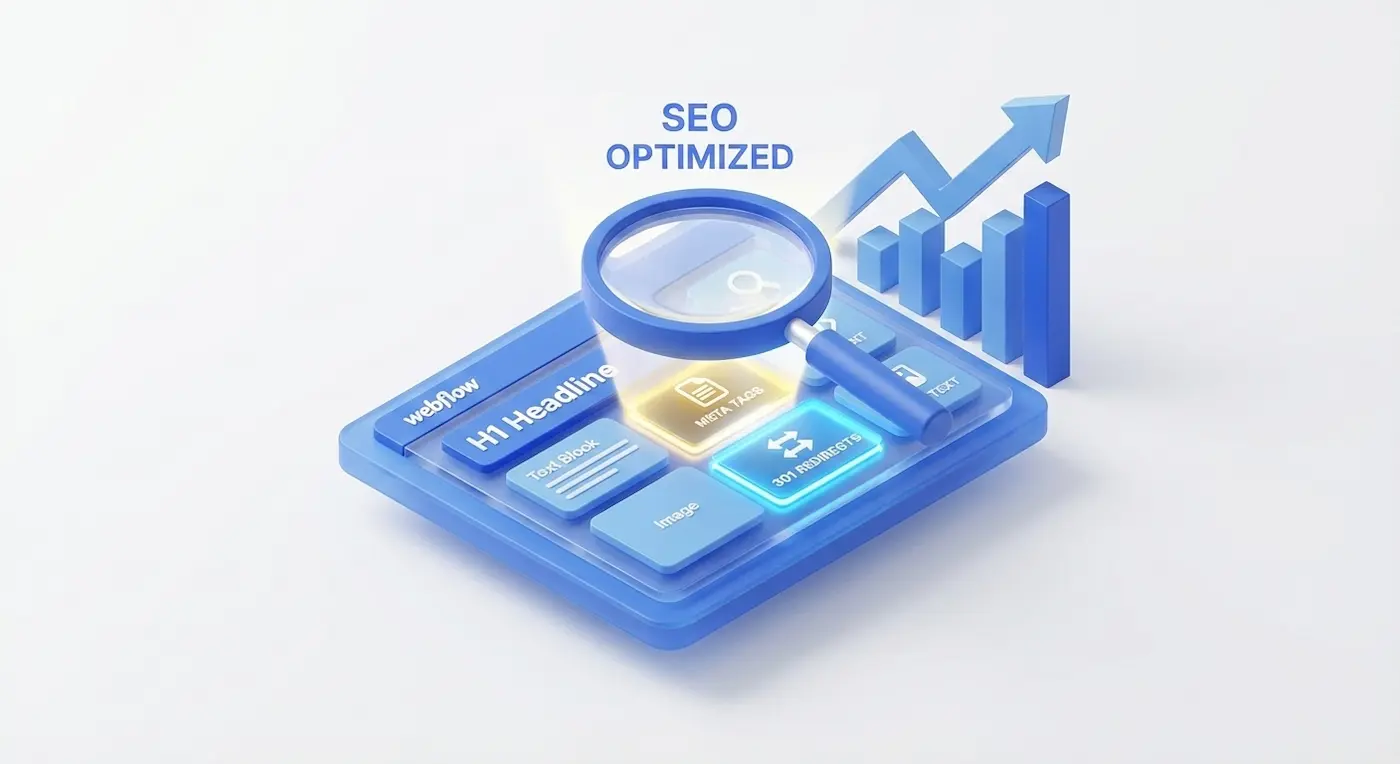
If your website’s DOM architecture is a mess, the AI will simply skip you and cite your competitor. Clean, semantic HTML, flawless mobile responsiveness, and perfect JSON-LD Schema markup (which we natively engineer in Webflow) are no longer optional SEO tactics—they are the mandatory price of admission to the new search ecosystem.
Summary: The End of Lazy SEO
Google's shift to AI-only search is not the end of SEO. It is the end of lazy SEO.
The companies that survive will be the ones that stop chasing generic keywords and start engineering websites built on proprietary data, real-world expertise, and flawless technical architecture.
Is your B2B website technically ready to be cited by Google’s new AI engine? Do not let your competitors become the default answer. Let’s audit your site's architecture and prepare it for the Zero-Click future.
Read new articles:







Рентабельные рекламные кампании в Яндекс.Директ
Настроим и будем вести контекстную и таргетированную рекламу для вашего бизнеса
Создадим систему привлечения новых клиентов
Уменьшим цену входящего звонка и заявки
Увеличим заказы на маркетплейсах: Ozon, Yandex Market, WB
Подготовим понятные отчеты и аналитику