
How to Generate High-Quality Leads in Complex Niches with Long Sales Cycles? A Google Ads Setup Guide for Equipment Manufacturers and B2B Companies.
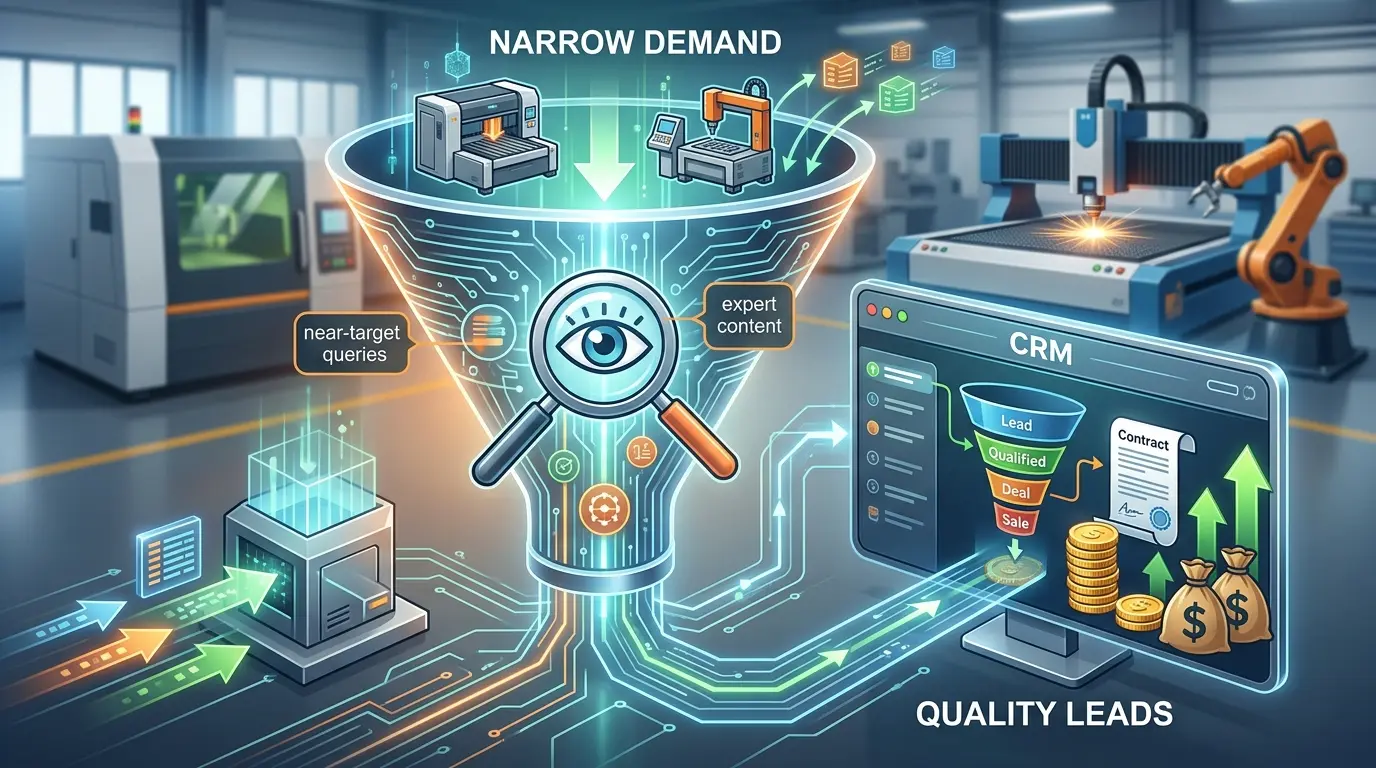
In the world of industrial marketing, classic PPC (pay-per-click) rules often fail. When your product isn't a pair of sneakers, but a million-dollar laser cutting machine or a warehouse automation system, the strategy of "bidding on the hottest query" leads to one of two problems: either there are zero leads due to a highly narrow demand, or they end up being unjustifiably expensive.
Industrial Google Ads is not about blindly "clicking buttons in the interface," but about possessing a deep understanding of the customer journey. Let's break down how to build a system that consistently generates quality leads in complex niches.
1. The "Vanishing Demand" Problem
In narrow niches, high-volume search queries (the ones people search for tens of thousands of times in Google Keyword Planner) simply do not exist. A query like "buy industrial extruder" might only have 40–60 impressions per month nationwide.
- What an average PPC specialist does: Expands the semantics with broad keywords (e.g., "plastic equipment"), which only brings in tons of junk traffic.
- What an expert should do: Work with problem-aware and solution-aware demand.
We are not just looking for people who already know the exact name of the machine; we are looking for those searching for a solution to their production pain points. For example, if you sell water purification systems for factories, your target queries should be:
- "Reducing boiler equipment wear and tear"
- "Wastewater treatment standards for food production"
- "Factory engineering systems design"
2. Expert Content as a Filter and Magnet
The main mistake of an industrial landing page is trying to sell head-on with a prominent "Order Now" button. In B2B, decisions take months and involve a buying committee: an engineer, a procurement officer, and a CFO.
Your landing page (especially if built on Webflow) should act as an expert consultant. Instead of aggressive calls to action, offer real value:
- Technical Data & Questionnaires: Allow the engineer to download specifications without forcing them into a mandatory phone call.
- ROI Calculators: Help the CFO financially justify the purchase.
- Case Studies: Show exactly how your equipment solved a problem at a real facility (include photos, actual numbers, and charts).
Crucial point: High-quality content on the site is your best filter. Random visitors will bounce, while the target client will instantly realize they are dealing with professionals.
3. The Hybrid Strategy in Google Ads: Search + GDN + Retargeting
In complex niches, you cannot rely on just one single tool.
- Search: We bid only on ultra-precise and SKU/article-specific queries. The CPC (cost per click) might be high here, but these are the "hottest" clients at the bottom of the funnel.
- GDN (Google Display Network): Here, we catch up with audiences based on their behaviors and custom intent. If a person visited competitors' websites or read articles about shop floor modernization, we display our expert materials to them across the web.
- Retargeting (Mandatory!): Because the sales cycle is long, we need 5 to 10 touchpoints with the client. We show them different ads sequentially: first, an invitation to a webinar, then an offer to download a product catalog, and finally, an invitation for an equipment test drive.
4. How to "Feed" the Neural Network in a Data Deficit
As we discussed in our article on auto-bidding strategies, Google's AI (Smart Bidding) needs data to optimize. In industrial B2B, actual conversions (signed contracts) are scarce.
The Solution for B2B: Train the system on micro-conversions that indicate a high intent to buy. For example:
- Downloading a price list.
- Visiting the "Contacts" page.
- Viewing more than 3 pages of technical specifications.
- Clicking the "Get Technical Consultation" button.
These actions happen 10 times more frequently than direct phone calls, providing the algorithm with enough "food" to understand the profile of your ideal customer and find more of them.
5. End-to-End Analytics: From Click to Shipment
In industrial marketing, you cannot measure success simply by "Cost per Lead" (CPL). A $10 lead might be a useless question from a university student writing a paper, while a $300 lead could turn into a $500,000 contract.
Integrating Google Ads with your CRM (like Salesforce, HubSpot, or Bitrix24) via end-to-end analytics systems allows you to see:
- Which specific keyword brought in the actual buyer?
- At what stage of the sales funnel do leads from advertising drop off?
- Which campaign brings not just phone calls, but actual bottom-line profit?
Conclusion
Industrial marketing does not forgive a superficial approach. It is a precise alloy of technical literacy, deep data analytics, and flawless UX on the website.
Our approach to managing Google Ads for complex niches rests on three pillars:
- Deep Product Immersion: We study your technological processes just as well as your own sales managers do.
- Content Strategy: We build a website that effectively persuades both engineers and directors.
- Transparent Numbers: You always know exactly how much profit every dollar invested in advertising brings back.
Read new articles:








Рентабельные рекламные кампании в Яндекс.Директ
Настроим и будем вести контекстную и таргетированную рекламу для вашего бизнеса
Создадим систему привлечения новых клиентов
Уменьшим цену входящего звонка и заявки
Увеличим заказы на маркетплейсах: Ozon, Yandex Market, WB
Подготовим понятные отчеты и аналитику